
Subscribe to our Forest Products Industry Newsletter
Emerging Regulatory and Technical Topics
- U.S. EPA released three new guidance memoranda on New Source Review (NSR) topics: begin actual construction, projected actual emissions, and reactivation. Read our blog for more information. Hopefully we will see additional helpful guidance-related actions in 2026 and perhaps some regulatory proposals.
- Regarding the Clean Water Act (CWA) Hazardous Substances Facility Response Plan (FRP) rule, there are now two actions at the Office of Management and Budget (OMB) for review:
- An amendment reconsideration.
- A compliance date delay and changes to reflect administration policy.
Based on what we have been hearing, we expect these actions to extend the compliance deadline by up to five years and solicit input from stakeholders on certain changes to the rule. We will be tracking updates and keeping our readers informed; in the meantime, check out our latest blog.
- In mid-November, U.S. EPA and the U.S. Army Corps of Engineers (U.S. ACE) released a pre-publication version of the proposed rule to amend the Waters of the United States (WOTUS) definition. The proposed definition is intended to be “durable” and fully implement the direction provided by the Sackett v. EPA SCOTUS decision. The proposed definition includes key terms such as “relatively permanent,” “tributary,” and “continuous surface connection” and revises and clarifies exclusions. The proposed definition does not consider ecological importance or impacts (resulting in concern from environmental groups) and is overall a significant narrowing of jurisdictional waters that are WOTUS.
- We are still waiting on the proposed changes to the Risk Management Program (RMP) Rule to be published. Look for an ALL4 blog soon after the proposal is signed to see what changes U.S. EPA is proposing.
- U.S. EPA has proposed a revised approach to its Toxic Substances Control Act (TSCA) risk analysis for formaldehyde that involves moving from a linear approach to a threshold approach and reversing unreasonable risk findings for five conditions of use, including adhesive use in wood products and paper manufacturing. This would be a significant win for the forest products industry if this approach is finalized.
- The scope of U.S. EPA’s one-time TSCA PFAS reporting rule could be narrowed and reporting delayed again. Look for an ALL4 blog this week for more information.
- U.S. EPA recently reorganized and renamed several offices. For example, the Office of Air and Radiation now includes the Office of Clean Air Programs, Office of State Air Partnerships, Office of Transportation and Air Quality, and the Office of Radiation and Indoor Air Quality. It could take a little while to remember that OAQPS is now OCAP… Organization charts and names of the current leadership are on their website.
Industry News

-
December 8, 2025 | ProAmpac to Acquire TC Transcontinental Packaging for $1.5 Billion Read more
-
December 5, 2025 | Environmental Paper Network Releases Paper Calculator Version 4.1 for Estimating Environmental Impacts of Paper Read more
-
December 3, 2025 | PCA to Permanently Shut Down No. 2 Containerboard Machine at Wallula Mill Read more
-
December 2, 2025 | Domtar to Permanently Close Crofton Pulp Mill in British Columbia Read more
-
November 17, 2025 | Kruger Products to Build New TAD Tissue Production Plant in Western U.S. Read more
-
November 14, 2025 | International Paper Announces Closures of Compton, California and Louisville, Kentucky Packaging Facilities as Part of Strategic Growth Initiative in North America Read more
-
November 5, 2025 | Graphic Packaging International begins operating Waco mill Read more
-
November 4, 2025 | NWPPA Recognizes Inland Empire Paper with 2025 Environmental Excellence Award Read more
-
November 3, 2025 | Saica Group breaks ground on new Indiana corrugated plant Read more
-
October 28, 2025 | TAPPI Appoints Lawton Roberts as New President & CEO; Larry Montague to Retire Read more
-
October 20, 2025 | Georgia-Pacific to Close Memphis Cellulose Mill and Memphis Technology and Innovation Center Read more
-
October 20, 2025 | Domtar’s Kingsport Mill Receives National Recognition for Sustainable Leadership Read more
-
October 16, 2025 | Sofidel to Expand Tissue Capacity in U.S with Installation of New TAD Tissue Machine Read more
-
October 11, 2025 | Pixelle Specialty Solutions Sells Chillicothe Paper Mill to Producer of Medical Gloves Read more
Safety Corner

OSHA’s Top 10 Most Frequently Cited Standards for Fiscal Year 2025
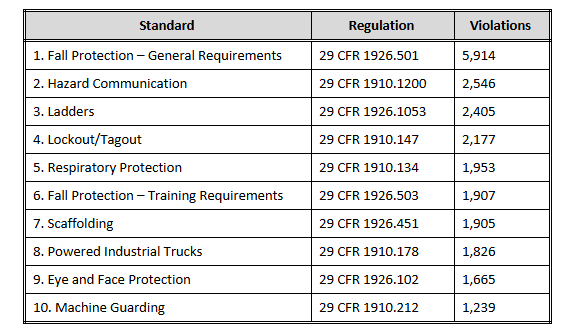
In September, the Occupational Safety and Health Administration (OSHA) released its preliminary list of the most frequently cited workplace safety standards for fiscal year (FY) 2025, with Fall Protection – General Requirements once again ranking first. This marks the 15th consecutive year that this standard has led OSHA’s citation list.
The data was unveiled at the 2025 National Safety Council’s (NSC) Safety Congress & Expo. The findings underscore ongoing compliance challenges and emphasize the continued need for stronger, more consistent safety practices across industries.
FY2025 Most Frequently Cited Standards
“While many organizations have made meaningful progress, the year-over-year consistency in these citation rankings shows there is still important work to be done,” said Lorraine Martin, CEO of the National Safety Council. “To better protect workers and save lives, the safety community must strengthen training, modernize performance metrics, identify and control high-hazard activities, and reinforce employee engagement and leadership accountability.”
The number of violations is likely to grow when the agency releases finalized data for FY 2025 in the spring of 2026 as the information is a preliminary list, which reflect OSHA Information System data collected from October 1, 2024, through August 12, 2025. Reach out to ALL4’s Victoria Sparks CSP, if you’d like assistance improving your health and safety programs.
Recent Relevant Webinars
-
Navigating Clean Water Act Citizen Suits – September 24th, 2025
-
RCRA Hazardous Waste Generator Reports – Yes, It’s Been Another Two Years – October 8th, 2025
-
Safety by Design: Building Culture Backed by Systems – November 19th, 2025
-
Water Regulatory Update – December 10th, 2025
- You can still sign up for the Refrigerants Webinar on December 17th!
Upcoming Events
Conferences
-
Pac Telecom (PTC), January 18-21, 2026.
-
IPMI EHS Management Institute, Jan 25-27, 2026.
-
NEWEA (New England Water Environment Association) 2026 Annual Conference January 25-28, 2026.
-
SWLA AWMA Spring Conference, February 26, 2026.
Training
- WASTE101 provides a foundational knowledge of various waste-related regulatory programs, with an emphasis on the Resource Conservation and Recovery Act (RCRA). The program covers the history of waste-related regulations and an overview of regulatory programs that impact industrial operations in various sectors, including forest products. You can register and listen to the recordings of our Fall 2025 sessions.
- Air Quality 101 (AQ101) Training provides a comprehensive and foundational knowledge of the Clean Air Act (CAA) and its various regulatory programs. The program covers the history of the CAA, NAAQS, and an overview of regulatory programs that impact industrial operations (e.g., New Source Performance Standards, Prevention of Significant Deterioration, air quality modeling, etc.). The program also covers more focused topics that are encountered day to day by facility environmental personnel such as the basics of emissions testing and continuous emissions monitoring. Our Fall 2025 program is in progress now – you can listen to recordings of the first several sessions to catch up.
- WATER101 provides a foundational knowledge of various water-related regulatory programs, with an emphasis on the Clean Water Act (CWA). The program covers the history of water-related regulations, water quality protections, and an overview of regulatory programs that impact industrial operations (wastewater permitting and discharge, stormwater permitting and discharge, contingency and response plans, and drinking water and water resources). The topics covered by WATER101 will be those encountered by environmental personnel in their real-world projects. Recordings of our Spring 2025 sessions are available now and we will offer this course again in 2026.
- Do you have budget left on a general assistance project with ALL4? You can use it to register for training – reach out to your project manager for information and a client discount code.
- ALL4 can develop customized EHS training programs for your staff – reach out to Lindsey Kroos for information!
Click here for a list of ALL4 conferences, webinars, trainings, and other events.
Upcoming Regulatory Deadlines
Do you have electronic reports due soon? Be sure to check the U.S. EPA Compliance and Emissions Data Reporting Interface (CEDRI) and the Electronic Reporting Tool (ERT) websites for updates. The ERT was last updated on September 2, 2025 and the CEDRI change log indicates the last revisions were in July 2025.
-
If you are subject to the Risk Management Program (RMP), you must do your annual emergency notification coordination exercise by December 31, 2025.
-
Are you ready for the new refrigerant rule compliance requirements that come into effect January 1, 2026? Have you developed your inventory of equipment that contains a charge of at least 15 pounds of refrigerants that contain hydrofluorocarbons (HFCs) and have a global warming potential greater than 53? Have you implemented procedures to ensure compliance with the new requirements of 40 CFR Part 84? If you need assistance with the new requirements, please reach out to your ALL4 project manager or Matt Dabrowski at mdabrowski@all4inc.com.
-
Annual, semiannual, and quarterly air compliance reports are due at the end of January (check your permit to see if the due date is January 30 or 31, 2026).
-
Reporting against projected actual emissions for recent projects may be due in the first 60 days of 2026.
-
Tier II inventories are due March 1, 2026.
-
Title V annual compliance certifications are due March 1, 2026 in some states.
-
RCRA Biennial Hazardous Waste Reports are due March 1, 2026.
-
Check your state’s requirements to see if you have an annual emissions inventory due in 2026 and when it is due.
Tips & Tricks
As the year comes to an end and we start thinking about collecting all our data for annual reporting, it’s an excellent opportunity to roll in and review chemical tracking and reporting required under the Emergency Planning and Community Right-to-Know Act (EPCRA). EPCRA has three ongoing components:
- Section 311 (Tier I) – Submittal of safety data sheets (SDS) to the local emergency response community
- Within 90 days of bringing onsite
- Section 312 (Tier II) – Submit an inventory of the hazardous chemicals stored on site
- By March 1 of each year
- Section 313 (Form R or TRI) – Submit a report of toxic chemical releases to the environment
- By July 1 of each year
Many of these tasks overlap with other annual reporting requirements typically found in air permits and it makes sense to streamline data collection for your facilities across multiple programs. New chemicals that were approved for use at the facility over the past year may alter usage or emissions tracking. New storage capacity of chemicals must be reflected in your annual Tier II report and many of the material throughputs used for annual air reporting are also critical inputs to the Toxic Release Inventory (TRI) reporting.
Spend some time now thinking about all the data you request from procurement, operations, logistics, or that you collect from your on-site data historians over the course of the year. Review how you can consolidate and streamline your data requests and review where and how you store the data in one database or workbook. Planning ahead will save you time as you prepare your EPCRA reports and help you to make friends with those you rely on for data across the facility by limiting last minute data requests throughout the year. If you need assistance or want to work through chemical data consolidation, please reach out to your ALL4 project manager or Scott Kirkpatrick.
Solutions Spotlight
Do you Know About Extended Producer Responsibility (EPR) Laws for Packaging?
Extended Producer Responsibility or EPR laws for packaging are being adopted in a growing number of states. The purpose is to ease states’ financial burden from municipal waste and recycling, and to encourage producers to use less packaging, and packaging that is more easily recycled. These laws transfer the financial burden of consumer packaging waste management from states and municipalities to the owners of the products’ brands. In general, the “producer” defined in these laws is not the manufacturer of the material, but the company whose logo appears on the packaging. This means that the EPR packaging costs fall to the owners of brands rather than the original material manufacturers.
Generally, EPR laws require producers to join a Producer Responsibility Organization to track producers’ packaging use and facilitate the assessment and collection of fees. Producers are required to submit a detailed list of the amount and types of packaging used in the state, and the PRO determines the cost of each type of material. The PRO bills the producer for their share of packaging waste and distributes the fees collected to municipalities to offset waste disposal costs.
Common components of EPR laws are:
- De minimis exemptions for companies selling less than a certain amount of products in the state,
- Exemptions for products like medication containers, infant formula, or essential agricultural products,
- Exemptions for packaging that never reaches the consumer (e.g., pallet wrap or pallets),
- A requirement that the PRO’s fees pay for administrative fees and the full cost of consumer curbside collection,
- Enforcement ranging from fines to producers being banned from selling in a state, and
- Most laws offer reduced fees for “Eco Modulation” such as high post-consumer recycled content in packaging or materials that are easily recycled.
Companies must make thorough inventories of the types and volumes of their packaging of products distributed in a state with a packaging EPR law and submit them to the PRO. Then the PRO assesses how much financial burden the company brings to the state’s waste management services based on their products’ cost for recycling or disposal in landfills. This data helps companies connect the cost for disposal to the product’s packaging and could lead to a determination that packaging in fiberboard rather than shrink wrap could reduce EPR fees, for example.
As of December 2025, seven states (Maryland, Washington, Minnesota, Colorado, California, Maine, and Oregon) have packaging EPR laws in place. In 2024 and 2025, 11 more states (Connecticut, Hawaii, Illinois, Massachusetts, New York, Nebraska Rhode Island, Tennessee, Michigan, New Jersey, and North Carolina) introduced EPR bills. According to the American Forest & Paper Association’s website, EPR programs can be effective when products are difficult to process or have low recycling rates or healthy end markets for recycled products do not exist; however, these issues do not apply to paper and paper-based packaging in the U.S. Paper recycling rates significantly outpace plastic recycling rates.
Do you need help understanding these requirements and how they could impact your business? Reach out for assistance.
In this time where there is a steady stream of regulatory and deregulatory news, stay tuned for ALL4 updates in our weekly newsletter, 4 The Record. Look for our annual Lookahead series in January on a variety of topics. Please reach out if you have any questions or suggestions for our next quarterly Forest Products newsletter.
Thanks,
Amy Marshall, Air Quality Practice Director
