
Illinois Data Centers – Fears for Tiers
Posted: June 11th, 2026
Author: Kelly Blackmon
Data centers in the state of Illinois may have some questions ─ or fears ─ about engine Tiers in their future. Big changes are coming that will impact data centers looking at future emergency engines: there’s a new rule requiring future backup generators at data centers to meet specific U.S. Environmental Protection Agency (U.S. EPA) Tier engine standards beyond what federal rules may require.
What exactly are these requirements?
On January 8, 2026, Senate Bill (SB) 0025 was signed by Governor Pritzker of Illinois. Its effective date is June 1, 2026.
While the title of this bill, “Swimming Facility Cold Spa,” sounds completely unrelated to data centers, a look at the full text shows that it actually contains some pertinent regulations. Pages 928-930 contain new requirements for data centers looking for construction permits for backup generators.
Starting six months after the effective date of this amendment (December 1, 2026), air permit applications submitted to the Illinois Environmental Protection Agency (IEPA) for most data centers will need to propose emergency diesel backup generators meeting U.S. EPA Tier 4 emissions standards for compression ignition engines. Previously, such emergency generators only needed to be certified to U.S. EPA’s Tier 2 or Tier 3 standards, dependent upon engine size, which is all that is required by the federal Standards of Performance in 40 CFR Part 60, Subpart IIII; engines do not require air pollution control devices (APCD) to meet Tier 2 and Tier 3 emissions values. Therefore, Illinois is requiring more stringent emissions standards for future diesel engines. This new requirement applies to Federally Enforceable State Operating Permit (FESOP, or IEPA’s equivalent to a synthetic minor permit) or Clean Air Act Permit Program permit (CAAPP, or IEPA’s equivalent to a Title V operating permit) sources, which account for the majority of data centers in the state.
It is important to note that this rule does not require Tier 4 certified engines to be installed. As of the date of this article, only U.S. EPA non-emergency diesel engines manufactured 2011 and later are required to be Tier 4 certified. Instead, this new rule requires that these future engines meet or exceed the Tier 4 emissions standards, or be what is called Tier 4 equivalent, similar to some California air districts and the recent legislative action in Virginia. Tier 4 equivalent is accomplished through a Tier 2 or Tier 3 diesel engine with add-on APCD, typically Selective Catalytic Reduction (SCR) systems for nitrogen oxides (NOx) reduction, Diesel Particulate Filter (DPF) for particulate matter (PM) reduction, and/or diesel oxidation catalyst (DOC) for carbon monoxide (CO) and volatile organic compounds (VOC) reduction. While several data centers across the U.S. install Tier 4 equivalent engines voluntarily, only a handful of state or local environmental agencies require this level of emissions control as a default for emergency diesel generators.
Emergency natural gas backup generators in air permit applications submitted on or after December 1, 2026, will need to meet U.S. EPA Tier 2 standards for spark ignition engines. Data centers are not used to associating engine Tier standards with gas-fired engines; more on that below. This new rule also highlights how backup engines may only operate as emergency or standby units in accordance with 35 Ill. Adm. Code 211.1920, and describes limitations on operations should the engines become non-compliant with the required Tier emissions standards. As a reminder, under 35 Ill. Adm. Code 211 emergency or standby units may only operate up to 50 hours per year in non-emergency situations, presuming the air permit does not restrict operating hours to a quantity less than that. IEPA has recently emphasized that the State and Federal definitions of emergency generators are not interchangeable, so extra care in reading both sets of regulations will be helpful.
Backup generators are instrumental to the operations of data centers, providing them with the ability to stay online when their primary power source is interrupted or unavailable. The generators are also the primary equipment at data centers subject to air quality regulations, and as such are the subject of increased focus from regulators, government representatives, and the public. Backup generators are therefore crucial to data centers, both operationally and regulatorily, so staying in compliance with federal, state, and local regulations is of the utmost importance.
What are U.S. EPA engine tiers?
Engine Tiers are classifications of engine set forth by U.S. EPA. Each Tier has a different set of emissions standards its engines must meet, based on the size and manufacture date of the engine. The compression-ignition (diesel engine) standards cover the following pollutants or combinations of pollutants: particulate matter (PM), nitrogen oxides (NOX), non-methane hydrocarbons (NMHC), the combination of NOX and NMHC, and carbon monoxide (CO). Tier 0 and Tier 1 standards are the least stringent as they applied to the earliest subject engines, with Tier 2 standards being more stringent for larger engines and Tier 3 standards being more stringent for smaller engines, etc. These Tier standards have been in place for more than 20 years, so most data centers are familiar with them for their diesel engines. The Tier 4 classification for diesel engines was created to reduce NOX and PM emissions further; Tier 4 was implemented through a phased-in approach of interim and final standards to allow engine manufacturers time to meet the requirements. U.S. EPA also established Tiers 1 and 2 for spark ignition engines.
The diesel engine Tier 4 standards are summarized in the table below.
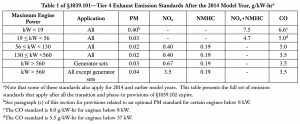
Table 1: From 40 CFR 1039.101(b)
U.S. EPA sets forth engine Tiers and their associated emissions standards for compression-ignition engines in 40 CFR Part 89 and 1039 and in 40 CFR 1048 for spark ignition engines. The responsibility of certifying diesel engines with the applicable Tier standards lies with the engine manufacturer, and the regulations are written with that in mind. For spark-ignition engines, there are very few manufacturer requirements for certification. Some manufacturers choose to certify certain gas-fired engines but for most large engines, the compliance burden lies with the end user rather than the manufacturer. The end users of any of these engines, in this case data centers, are responsible for purchasing the correct Tier engine and/or APCD to comply with federal or state regulations that apply to their facility. They are also responsible for installing, operating, and maintaining the engines properly and in accordance with manufacturer recommendations, conducting performance testing if required to demonstrate compliance with emissions standards (for many gas-fired engines), and modifying only those emissions settings allowed by the manufacturer. Not meeting these responsibilities can void the certification of the engine, in addition to creating a non-compliant regulatory situation.
What does this mean for my facility?
This rule makes no mention of any changes for existing backup generators at data centers, only new generators at data centers requiring a construction permit. While you may be tempted to submit construction permit applications before December 1 of this year, which for some facilities may be strategic, please note that there is a 12-month deadline to begin construction of emissions units once a construction permit is granted. If you will not be able to commence construction for your new backup generators within that timeframe, the construction permit will expire and you will need to apply again, which will subject your proposed engines to these new standards.
If you are considering spark ignition engines, know that they are different from both the diesel Tier 2 standards and from the emergency generator emissions standards in 40 CFR Part 60, Subpart JJJJ.
You may also have other questions like: What if I need to change generators that are already permitted but not yet installed? What if I need more operating hours or fuel consumption for my current generators? Is there risk to my current generators if I expand? Will I need to stack test to demonstrate compliance with the new requirement?
Still have questions?
ALL4 supports data center clients across the U.S. in navigating planning, permitting, compliance, and sustainability requirements. Whether you’re planning new locations, considering onsite generation, optimizing internal processes for compliance, or responding to emerging environmental pressures, we’d love to learn what’s important to you and explore how we can help. If you have any questions about how to comply with these new standards or have questions relating to air quality regulations and data centers, please feel free to contact me at kblackmon@all4inc.com, or my colleagues Brian Goldman and Sharon Sadler at bgoldman@all4inc.com or ssadler@all4inc.com.
