The Occupational Health and Safety Administration (OSHA) identifies Indoor Air Quality (IAQ) as an important consideration for workplace health and safety as well as worker comfort. In all workplaces, instances of poor IAQ can lead to symptoms of headache, fatigue, and trouble concentrating, all of which can potentially lead to reduced worker safety and productivity. Workplaces with the potential for exposure to airborne contaminants such as particulates (dusts), biological agents, and chemical vapors, must ensure ventilation is adequate to protect worker health. There are many ways to address IAQ, but proper ventilation can be one of the most effective means.
What is Ventilation?
Ventilation improves IAQ within a facility by replacing stale, often contaminated indoor air with fresh outdoor air. Once the air is introduced into the facility, it is distributed to maximize infiltration of the fresh air. When discussing IAQ and ventilation, one common description used is the number of air changes per hour (ACH) which is the number of times within one hour that the entire volume of air is replaced in a space. For example, if a facility wanted 10 ACH, that would require a complete volumetric air exchange every 6 minutes. Depending on the size of the space, that’s a lot of air to move! Most office workplace settings achieve 1.5 ACH due to the use of recycled air. Air is typically recycled in conditioned spaces to improve energy efficiency and performance of the air handling system. In many manufacturing settings, recycling conditioned air is difficult because of dust and other hazards present in the facility. In these instances, all newly introduced air is fresh outside air that is conditioned once to create a comfortable working environment. With the introduction of fresh air, the stale, contaminated air must be removed or exhausted from the facility. The building or facility itself should have a general exhaust system that removes stale air, but local exhausting may also be necessary. Local exhaust ventilation is important when working with hazardous chemicals and airborne contaminants. Local exhaust ventilation systems include:
- Capturing hoods (welding/grinding)
- Enclosures (fume hoods and biological safety cabinets)
- Downdraft tables
- Mobile, flexible extractor arms
The most commonly considered ventilation type is mechanical ventilation which uses machines and mechanical means to provide ventilation to spaces, but natural ventilation can be a powerful tool as well. Natural ventilation relies on air’s typical tendencies to create air exchange within a space. This includes thermal buoyancy which uses temperature differences between indoor and outdoor environments and the fact that hot air rises, often combined with wind driven methods. In addition, hybrid methods can prove very beneficial depending on the space and facility needs.
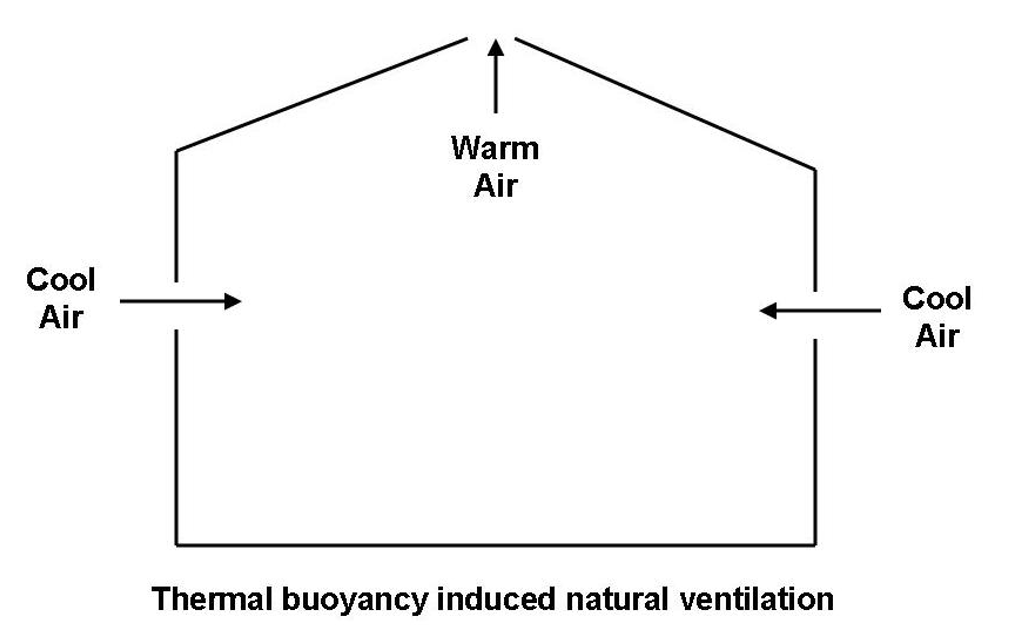 Figure 1: Thermal buoyancy induced natural ventilation uses a temperature difference between internal and external conditions to drive warm, stale, contaminated air out of a space.1
When Does Ventilation Matter?
Manufacturing and production facilities may use hazardous chemicals in production or create contaminants as part of the process that need to be managed for worker safety. When working with airborne contaminants it is important to follow the hierarchy of controls. The hierarchy of controls is a 5-level framework used to minimize or eliminate exposure to hazards ranked from most effective to least effective:
- Elimination
- Substitution
- Engineering Controls
- Administrative Controls
- Personal Protective Equipment (PPE)
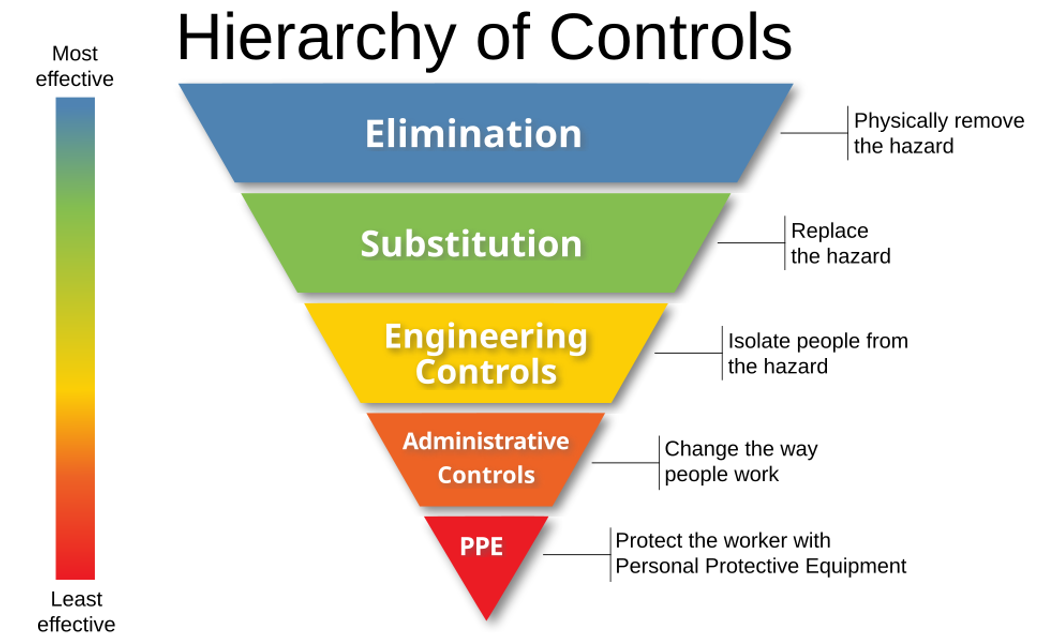
Figure 2: Hierarchy of Controls from most effective to least effective with definitions.2 When airborne contaminants cannot be effectively eliminated or substituted, engineering controls must be evaluated. Engineering systems for airborne contaminants can include local exhaust ventilation systems such as exhaust hoods, fume hoods, or other appropriate control methods. PPE is the final hierarchy of control and the least effective, so proper ventilation should be one of the first actions taken. Engineering controls such as dust control systems are used to remove containments from the production or manufacturing area, but if a dust control system isn’t properly balanced with a mechanical heating, ventilation, and air conditioning (HVAC) system, the facility and dust control system may not operate properly. It is important to ensure all ventilation engineering controls operate optimally and as designed to ensure maximum worker safety benefits. Proper ventilation is also vitally important in facilities where moisture in the air is a concern. Air with higher levels of moisture present can create issues with production for moisture sensitive products as well as leading to mold and other issues. Providing proper conditioning methods, exhausting systems, and other ventilation techniques can help eliminate these problems.
How Can ALL4 Help?
ALL4 has the ability and expertise to help with many ventilation issues. This includes conducting indoor air quality assessments, and ventilation assessments to determine if your HVAC system is balanced, the effectiveness of local exhaust systems, and evaluating a facility to address mold, high moisture levels and other ventilation needs. In addition, we can provide recommendations on ways to improve your facility through natural and mechanical ventilation techniques to improve indoor air quality. ALL4 can also help with any testing and monitoring needs for quantifying worker exposure levels to contaminants. Types of ventilation work ALL4 has conducted include:
- Conducting occupational exposure assessments and assessing HVAC systems and local exhaust ventilation systems to evaluate the need for respiratory protection.
- Indoor air quality assessments, evaluating various indoor air quality parameters such as temperature, relative humidity, carbon monoxide, carbon dioxide and volatile organic compounds to evaluate the effectiveness of the facility HVAC systems.
- Identifying ventilation issues in high moisture environments in the distilled spirits industry.
- Face velocity testing in fume hoods.
- Conducting air speed analyses for cadaver tables and ventilation systems.
For inquiries about how ALL4 can help with your ventilation needs, contact Staci McGill at smcgill@all4inc.com.
1
https://afs.mgcafe.uky.edu/poultry/chapter-7-natural-ventilation-systems 2National Institute for Occupational Safety and Health (NIOSH); Hierarchy of Controls