
OSHA Injury And Illness Recordkeeping: Key Requirements and Compliance Considerations
Posted: March 12th, 2026
Author: Shawn Anderson
Occupational Safety and Health Administration (OSHA) injury and illness recordkeeping under 29 CFR §1904.7 is more than just filling out OSHA log Forms 300, 301, and 300A – it’s about capturing accurate workplace data that reflects your safety culture, supports defensible compliance, and withstands regulatory scrutiny. With recent interpretive guidance, expanded electronic reporting, and ongoing enforcement trends, getting this right is essential for both frontline operations and leadership confidence in identifying and eliminating workplace hazards, preventing future incidents.
Let’s clarify what matters and where organizations routinely go wrong.
OSHA Forms
- The 300 (Log) is an ongoing, year-long log of specific, anonymized incident details.
- The 300A (Summary) is a mandatory, signed annual total of incidents (no names) posted from Feb-April.
- The 301 (Incident Report) is a detailed, confidential, case-by-case report for each injury
Who Must Maintain OSHA Injury and Illness Records?
Employers with more than 10 employees must maintain OSHA records unless they fall under a partially exempt North American Industry Classification System (NAICS) code. This exemption applies only to routine logs—not to OSHA’s mandatory fatality and severe injury reporting requirements.
Look for your NAICS code in the list under Appendix A to Subpart B of 29 CFR §1904 of low-hazard industries that are partially exempt from routine recordkeeping for OSHA injury and illness records.
For employers with more than 10 employees that are not partially exempt, records must be maintained for five years. The 300A must be certified by a company executive and posted in a conspicuous place or places where notices to employees are customarily posted, such as a breakroom or bulletin board, from February 1–April 30 annually.
Understand What Makes a Case Recordable and Properly Classify Case Outcomes
Determining Recordability
Often, determining whether a workplace injury is recordable or not comes down to the distinction of whether first aid was given or if medical treatment beyond first aid was given.
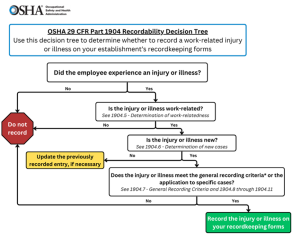
Image Source: https://www.osha.gov/recordkeeping
OSHA First Aid Definition (Non-Recordable)
The distinction between first aid and medical treatment is often misunderstood. OSHA defines medical treatment and first aid in 29 CFR §§1904.7(b)(5)(i) and (ii), respectively, as:
- Bandaging, hot/cold therapy, draining blisters, temporary immobilization devices, non-prescription medication at non-prescription strength is first aid.
- Prescription medication, regardless of whether it is filled, is medical treatment and makes the case recordable.
- Sutures, physical therapy, or rigid immobilization devices are medical treatment.
Organizations should ensure supervisors and occupational health providers understand these distinctions in 29 CFR. § 1904.7(b)(5), as misclassification remains a common citation basis.
Work-Relatedness Determinations and Classification
OSHA presumes an injury is work-related if it occurs in the work environment while the employee is present as a condition of employment unless a specific exception applies. Determining work-relatedness can be challenging because it often requires evaluating complex causation factors, including pre-existing conditions, multiple exposures, and activities occurring both inside and outside the work environment. Limited medical evidence or incomplete incident information can make it difficult to clearly establish whether a workplace event or exposure caused or significantly aggravated the condition. Employers must apply the criteria in 29 CFR §1904.5 objectively.
For practical implication, employers should document their work-relatedness analysis and ensure consistency across similar cases. Workers’ compensation determinations do not govern OSHA recordability.
After a determination has been made that the incident is recordable, each recordable case must be classified in one of the following categories on the OSHA forms:
- Days Away from Work (DAFW) – beginning on the day after the injury occurred or the illness began.
- Job Transfer or Restriction (i.e., a physician or other licensed health care professional recommends that the employee not perform one or more of the routine functions of his or her job, or not work the full workday; or the employer keeps the employee from performing one or more of the routine functions of his or her job).
- Other Recordable Cases – a work-related injury or illness requiring medical treatment beyond first aid but does not result in death, DAFW, restricted work, or job transfer.
Employers should track days carefully; count calendar days not scheduled workdays, and stop counting at 180 days.
From a risk management standpoint, misclassifying Days Away, Restricted, or Transferred (DART) and DAFW cases artificially lowers your Total Recordable Incident Rate (TRIR) or DART rate. During enforcement actions, OSHA often recalculates these metrics and identifies systemic underreporting. Ensuring data accuracy helps manage internal safety programs, enabling better worker protection by identifying recurring injuries, trends, and ultimately to implement better safety prevention measures.
Electronic Submission and OSHA’s Injury Tracking Application
OSHA’s expansion of electronic reporting requirements through the Injury Tracking Application (ITA) continues to reshape how injury data is used. Injury and Illness data is due March 2nd for the previous year.
YOU MUST submit 300A summary data if your establishment meets one of the following criteria:
- 250 or more employees and is not in an industry listed in the Exempt Industries list in Appendix A to Subpart B of OSHA’s recordkeeping regulation of 29 CFR Part 1904, or;
- 20-249 employees and is in an industry listed in Appendix A to Subpart E of 29 CFR Part 1904.
YOU MUST also submit 300/301 case-level data if your establishment(s) has 100 or more employees and is in an industry listed in Appendix B to Subpart E of 29 CFR Part 1904.
State and local government employers covered by a State Plan may be required to submit 300A and 300/301 data and should also contact their State Plan or guidance about what is required to be submitted.
OSHA uses these submissions for targeted inspections, and the data forms the basis of the Bureau of Labor Statistics Annual Survey of Occupational Injuries and Illnesses for public transparency. Organizations should confirm that their incident management systems align with OSHA’s reporting fields to avoid discrepancies during electronic submission.
Practical Steps for Employers
To reduce recordkeeping risk, organizations should consider:
- Completing a thorough investigation at the time an incident occurs and keep detailed incident records.
- Conducting annual internal recordkeeping audits.
- Providing targeted training on determining first aid vs. medical treatment beyond first aid.
- Documenting work-relatedness analyses.
- Reviewing incentive programs for unintended reporting disincentives.
- Verifying data consistency prior to ITA submission.
Final Thoughts
OSHA injury and illness recordkeeping is more than a compliance obligation – it’s a tool that reflects your safety priorities, informs risk management decisions, and supports a data-driven approach to workplace safety.
By staying current with interpretive guidance, electronic reporting requirements, and best practices in recordkeeping culture, you strengthen both regulatory compliance and employee trust. And with ALL4’s proven EHS consulting support behind you, you don’t have to do it alone.
If you’re ready to assess or enhance your OSHA recordkeeping program, reach out to an ALL4 Occupational Safety and Health Consultant, Shawn Anderson at sanderson@all4inc.com.
