Proposed Revisions to the NESHAP for Marine Tank Vessel Loading Operations (MTVLO)
Author: Eric Swisher
The U.S. Environmental Protection Agency (U.S. EPA) has conducted its required periodic technology review and proposes to amend the National Emission Standards for Hazardous Air Pollutants (NESHAP) for Marine Tank Vessel Loading Operations (MTVLO) codified at 40 CFR Part 63, Subpart Y. The proposed revisions to the MTVLO NESHAP were published in the Federal Register at 91 FR 10559 on March 4, 2026. Comments must be submitted to the docket (Docket ID No. EPA–HQ– OAR–2025–0207) on or before April 20, 2026. Companies with MTVLO should consider commenting. U.S. EPA is soliciting comments on 31 specific items concerning developments in practices, processes, and control technologies that reduce emissions of hazardous air pollutants (HAP) from MTVLO. The wide range of topics requested for comment by U.S. EPA provides opportunities for input on proposed revisions to the MTVLO NESHAP. The topics on which U.S. EPA is requesting comments include:
- Submittal of any additional information, including control device developments, that could enhance U.S. EPA’s technology review;
- Applicability and exemptions;
- Overlap provisions for facilities subject to other emissions standards;
- Proposed compliance dates for implementation of the revisions;
- Leak detection, monitoring, and work practices;
- Removal of startup, shutdown, malfunction (SSM), affirmative defense, and maintenance allowances;
- Ongoing performance testing, flare monitoring, and sampling methods;
- Operating and emissions limits;
- Editorial/technical clarifications; and
- Electronic reporting requirements.
U.S. EPA last finalized changes to the rule in 2011 when it completed its risk and technology review. For this technology review, U.S. EPA has proposed a determination that there are no new technologies for emissions control relevant to the source category and that any improvements in required control efficiency would not be cost effective. For example:
- U.S. EPA proposes not to require loading emissions controls for MTVLO sources below the major source threshold due to cost;
- U.S. EPA proposes to retain the <1.5 pounds per square inch absolute (psia) vapor pressure exemption due to cost (instead of determining that it is a regulatory gap that must be filled); and
- U.S. EPA determined that adding leak detection and repair (LDAR) requirements for liquid components or reducing the leak definition or frequency of monitoring for the existing LDAR requirements is not necessary due to cost and that minimal HAP emissions reductions that would be achieved. They do, however, propose some clarifications to the LDAR requirements.
Also of particular interest in the proposed revisions to the MTVLO NESHAP are updates to the maintenance allowance provisions, ongoing performance testing requirements, and flare monitoring requirements. Specifically, U.S. EPA is proposing:
- Removal of the maintenance allowance provisions, which exempted certain maintenance activities from being treated as deviations or violations and allowed extra time beyond standard repair deadlines for equipment taken out of service for maintenance or repair.
- Updated performance testing requirements, which would add a requirement to perform ongoing performance testing for non-flare, combustion type control devices every 60 calendar months, and changes to how operating parameter limits are set.
- Additional electronic reporting requirements.
- Enhanced monitoring for MTVLO that vent to flares based on the requirements of 40 CFR Part 63, Subpart CC – Petroleum Refineries NESHAP. This change would require monitoring of the flare vent/supplemental gas and steam/air assist volumetric flow rates, heating value of the vent gas, flame presence, and visible emissions.
U.S. EPA proposes that compliance with the additional electronic reporting requirements be achieved within 180 days of the final rule, compliance with the flare monitoring changes be achieved within three years of the final rule, and compliance with all other new requirements be achieved on the effective date of the final rule.
Comments should consider both the preamble discussion of the technology review and U.S. EPA’s “Redline of 40 CFR Part 63, Subpart Y, Showing Proposed Amendments” posted in the docket. The redline version of the rule was provided by U.S. EPA as a “convenience” but it also presents the manner in which the proposed revisions discussed in the preamble would be incorporated into a final rule. For example, the Federal Register notice discusses the addition of annual relative accuracy test audits (RATAs) for control devices that use Continuous Emissions Monitoring Systems (CEMS) for compliance. However, the redline version of the rule incorporates the requirement to complete a RATA by requiring the CEMS to meet 40 CFR Part 60, Appendix F – Procedure 1 [Appendix F (P1)]. Appendix F (P1) does include the requirement of a RATA, but it also includes quarterly Cylinder Gas Audits (CGA) and even competing definitions with 40 CFR Part 63, Subpart A – General Provisions for periods when the CEMS are deemed out-of-control.
Comments on proposed rules do not always have to focus on “the bad” or on items you oppose or wish to clarify. If there are parts of the existing rule or proposed revisions you consider as “the good” (changes or parts of the analysis you agree with), comments should be submitted in support of the proposed requirements or changes that were considered but not proposed to ensure U.S. EPA considers the true impact of potential changes. For example, if the cost of implementing a change would be even higher than U.S. EPA estimated, that information should be provided. If compliance with the flare monitoring requirements will take three years to achieve, a compliance timeline could be developed and submitted to support that timing.
Providing U.S. EPA with effective comments on proposed rule revisions is both an “art” and a “science.” Comments should be developed based on input from various stakeholders within a company or industry. The MTVLO NESHAP impacts work tasks for loading operations and logistics, instrumentation, maintenance, environmental, and potential subcontractors used as part of LDAR programs. Each stakeholder has a valuable perspective and their input should be considered when developing comments. Comments provided to U.S. EPA on the proposed MTVLO NESHAP revisions may:
- Affect the outcome of the final regulation,
- Provide additional technical or economic information,
- Support existing requirements or proposed revisions, and/or
- Seek clarification on how proposed changes would be implemented.
ALL4 has extensive experience evaluating proposed regulatory actions, determining impacts of proposed changes, and preparing technical comments that impact final outcomes. We implemented enhanced flare monitoring programs for many facilities and can help you evaluate gaps in your program. For more information on the MTVLO NESHAP, or assistance in evaluating the impact of the proposed revisions and preparing comments for submittal to U.S. EPA, please contact Eric Swisher at eswisher@all4inc.com.
Requirements vs. Wish Lists: Translating EHS Program Needs into Implementable System Designs
Authors: Julie Taccino & Rena Wolinsky
What is a Software Requirement?
Well-developed software requirements are the foundation of successful strategic preparation for software projects (often called “Phase 0s”), digital selections, and digital implementations. If the requirements defined don’t match a process, the software can add frustration and appear to be lacking features or functionality. When requirements are well-written and thorough, project success is more likely, and meeting all the requirements leads the user community to acceptance of the project and/or product as effective and useful.
At the start of every digital project, the business team [usually environmental, health, and safety (EHS) professionals] and the Information Technology (IT) teams have a “wish list” of features or tasks the software should be able to do. In this list, there are usually some things that are simple to implement, and some that may be complex and less practical. Business or IT teams not familiar with EHS Software often cannot tell the difference between the two extremes. How do you get from this wish list to a list of requirements that match your business process and can be successfully implemented?
Steps to Refine Wish Lists into Software Requirements
Here are some steps that help develop projects goals into discrete requirements that can lead to project success and user acceptance:
- Consolidate wish lists from all stakeholders into one requirements list. Remove any duplicate requirements and refine the requirement list.
- Note that the best practice is to do the duplicate clean up before further refining the list.
- Consider the full picture when making a requirement list. The importance of input from all stakeholders can’t be overstated. Areas that are often overlooked include:
- EHS reporting requirements.
- IT requirements such as single sign on (SSO), cybersecurity, and/or internal Digital Privacy Impact Assessment (PIA).
- The end user experience (e.g., iPhone vs. Android mobile usage).
- Permissions – which people or what groups should be able to see and edit what information at various stages.
- Notification triggers, subjects, bodies, and recipients should be explicitly stated in requirements.
- Determine which requirements are “must haves” versus “nice to haves.”
- Discussion between different EHS professionals and multiple stakeholders may be required.
- If all requirements are being called “must haves,” then revisit with a tighter filter to determine which requirements are truly mission critical.
- Re-write requirements as needed using IT team members and EHS team members. IT team members can help balance specifics with broadness to create software requirements that can be implemented.
- Good requirement example: Need to have triggering questions to show or hide groups of conditional audit questions.
- Example requirement that is too broad: Need to be able to have some conditional display audit questions.
- Review with all stakeholders to be sure that any critical information has not been lost in the refining process and that they are aligned to what a successful implementation would look like. The more complete and concrete the requirements are, the smoother the digital selection or implementation will go for all parties.
Note that it is normal to desire scope changes or feature changes after implementation once users get into the system. Change design can also be discussed and implemented later.
A successful digital project starts with translating the EHS business team’s wish list into implementable software requirements. The above steps are a high-level process for crafting solid requirements. If you would like to discuss more, please contact Rena Wolinsky at rwolinsky@all4inc.com or 732-858-4013 or Julie Taccino at jtaccino@all4inc.com or 281-201-1247.
Ladder Safety Month
Author: John Kelleher
March is Ladder Safety Month
In March, the American Ladder Institute (ALI) celebrates the 10th National Ladder Safety Month , designed to raise awareness of ladder safety and decrease the number of ladder-related injuries and fatalities. The American Academy of Orthopedic Surgeons reported in 2023 that approximately 500,000 people are treated for ladder-related injuries each year. Approximately 300 of these incidents prove to be fatal. Most ladder-related deaths are from falls of 10 feet or less. ALI believes that many ladder safety incidents are preventable, and through increased awareness and training, the number of ladder-related incidents can decline. The ALI has outlined the following themes for each week of Ladder Safety Month:
- Week One: Choosing the Right Ladder
- Week Two: Check Before You Climb
- Week Three: Set It Up Safely
- Week Four: Climb Safely, Work Safely
- Week Five: Safe Steps with Stepstools
Elevate Your Ladder Safety Program
With National Ladder Safety Month upon us, now is a great time to evaluate ladder safety in your workplace. Do you have an effective ladder safety program and training for your workplace? At a minimum, if you use ladders at your workplace, you must comply with the applicable Occupational Health and Safety Administration (OSHA) regulations including Subpart D – Walking-Working Surfaces, and 29 CFR §1910.23 (Ladders) in General Industry and 29 CFR §1926.1053 (1926 Subpart X, Stairways and Ladders) in the Construction industry. Utilize Ladder Safety Month as a time to increase awareness and improve ladder safety at your workplace.
Take a step in the right direction and make sure your workplace follows these ladder safety tips:
- Ensure your ladder selection is the right one for the job. Match the ladder type (duty rating), material, and size to the task and environment. A ladder’s duty rating indicates its maximum safe load capacity, including the user’s body weight, clothing, protective gear, and any tools or materials carried.
- Inspect your ladder before each use. Look for cracks, bends, loose or missing screws and bolts, or other signs of wear and tear. Do not use damaged ladders; remove them from service immediately.
- Keep ladders away from electrical hazards. When working near electrical lines or equipment use nonconductive ladders, such as those made from fiberglass, or dry wood ladders. Never use metal ladders near electrical equipment.
- Set up and position your ladder effectively. Ensure ladders are set on a stable, firm, and level surface. Never place ladders on top of other items like boxes or pallets for increased height. For extension ladders, for every four feet of vertical height a ladder rises, its base should be placed one foot away from the wall or structure. When using an extension ladder to access a roof or upper landing, the side rails must extend at least three feet above the landing surface to provide handholds.
- When climbing a ladder, use the following safety practices:
- Maintain three points of contact: When climbing up or down, or while working, always maintain a three-point contact (two hands and one foot, or two feet and one hand) with the ladder. Use toolbelts to assist with carrying things when on a ladder.
- Face the ladder when climbing or descending, stay centered when using the ladder and avoid reaching or leaning to one side or the other.
- When storing ladders, secure them to prevent them from falling over or obstructing walkways, and keep them in a dry, cool place to prevent wear and tear.
- Ensure employees who are responsible for using ladders at your workplace are trained in the proper inspection, selection, safe working practices, and storage of ladders.
Unsure on where your organization stands in ladder safety? ALL4 can help you evaluate your ladder safety program and take it to the next level. For more information about how ALL4 can help support your ladder safety program, contact John Kelleher at jkelleher@all4inc.com or (774) 249-3497.
New PFAS Reporting Requirement In Minnesota
Author: Colleen Nagel
The Minnesota Pollution Control Agency (MPCA) has extended the initial reporting deadline for intentionally added per-and polyfluoroalkyl substances (PFAS) in products sold in Minnesota and online to July 1, 2026. The finalized rule was adopted after a two-year rulemaking process following Amara’s Law, which was originally promulgated in May 2023. The reporting requirements include, but are not limited to:
- A brief description of the product or a description of the category/type of product
- Identification of the PFAS chemicals used in the product or its components
- The concentration of PFAS chemicals in a product or components of a product made up of homogeneous material
- The function that each PFAS chemical provides to the product or its components
- Identification of manufacturer, as defined under Minnesota Statue §116.943(o), of product(s)
- Contact information for the authorized representative of the manufacturer and an alternative to the authorized representative
- A one-time flat fee of $800 per manufacturer to cover the State’s cost of implementation of the new rule
The complete list of requirements is listed under Minnesota Rule Chapter 7026.0030 (Minn.R.ch.) Reporting exemptions are listed under Minn.R.ch.7026.0090. The six-month extension from the original January 1, 2026 deadline was provided to allow manufacturers more time to become familiar with the new reporting system, PFAS Reporting Information System for Manufacturers (PRISM), and to allow time for supplier agreements for the suppliers reporting on behalf of the manufacturers as part of this new rule.
The information submitted within PRISM, not marked as trade secret, will be available to the public and maintained on a continual basis. Subsequent annual reports will be due each year by February 1.
Next Steps
Prior to the July 1, 2026 reporting deadline, ALL4 recommends completing an inventory of the products utilized at your facility to assess for products containing intentionally added PFAS.
For additional information on the PFAS reporting requirements in Minnesota, email updates are available through GovDelivery. If you have any questions or would like assistance in evaluating how your facility is impacted by the Minnesota PFAS ruling, please reach out to me at cnagel@all4inc.com. ALL4 will continue to track updates to additional guidance or rulemaking regarding PFAS reporting in Minnesota.
OSHA Injury And Illness Recordkeeping: Key Requirements and Compliance Considerations
Author: Shawn Anderson
Occupational Safety and Health Administration (OSHA) injury and illness recordkeeping under 29 CFR §1904.7 is more than just filling out OSHA log Forms 300, 301, and 300A – it’s about capturing accurate workplace data that reflects your safety culture, supports defensible compliance, and withstands regulatory scrutiny. With recent interpretive guidance, expanded electronic reporting, and ongoing enforcement trends, getting this right is essential for both frontline operations and leadership confidence in identifying and eliminating workplace hazards, preventing future incidents.
Let’s clarify what matters and where organizations routinely go wrong.
OSHA Forms
- The 300 (Log) is an ongoing, year-long log of specific, anonymized incident details.
- The 300A (Summary) is a mandatory, signed annual total of incidents (no names) posted from Feb-April.
- The 301 (Incident Report) is a detailed, confidential, case-by-case report for each injury
Who Must Maintain OSHA Injury and Illness Records?
Employers with more than 10 employees must maintain OSHA records unless they fall under a partially exempt North American Industry Classification System (NAICS) code. This exemption applies only to routine logs—not to OSHA’s mandatory fatality and severe injury reporting requirements.
Look for your NAICS code in the list under Appendix A to Subpart B of 29 CFR §1904 of low-hazard industries that are partially exempt from routine recordkeeping for OSHA injury and illness records.
For employers with more than 10 employees that are not partially exempt, records must be maintained for five years. The 300A must be certified by a company executive and posted in a conspicuous place or places where notices to employees are customarily posted, such as a breakroom or bulletin board, from February 1–April 30 annually.
Understand What Makes a Case Recordable and Properly Classify Case Outcomes
Determining Recordability
Often, determining whether a workplace injury is recordable or not comes down to the distinction of whether first aid was given or if medical treatment beyond first aid was given.
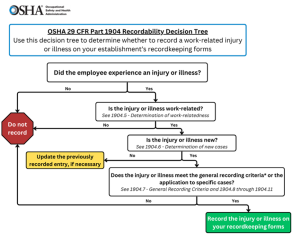
Image Source: https://www.osha.gov/recordkeeping
OSHA First Aid Definition (Non-Recordable)
The distinction between first aid and medical treatment is often misunderstood. OSHA defines medical treatment and first aid in 29 CFR §§1904.7(b)(5)(i) and (ii), respectively, as:
- Bandaging, hot/cold therapy, draining blisters, temporary immobilization devices, non-prescription medication at non-prescription strength is first aid.
- Prescription medication, regardless of whether it is filled, is medical treatment and makes the case recordable.
- Sutures, physical therapy, or rigid immobilization devices are medical treatment.
Organizations should ensure supervisors and occupational health providers understand these distinctions in 29 CFR. § 1904.7(b)(5), as misclassification remains a common citation basis.
Work-Relatedness Determinations and Classification
OSHA presumes an injury is work-related if it occurs in the work environment while the employee is present as a condition of employment unless a specific exception applies. Determining work-relatedness can be challenging because it often requires evaluating complex causation factors, including pre-existing conditions, multiple exposures, and activities occurring both inside and outside the work environment. Limited medical evidence or incomplete incident information can make it difficult to clearly establish whether a workplace event or exposure caused or significantly aggravated the condition. Employers must apply the criteria in 29 CFR §1904.5 objectively.
For practical implication, employers should document their work-relatedness analysis and ensure consistency across similar cases. Workers’ compensation determinations do not govern OSHA recordability.
After a determination has been made that the incident is recordable, each recordable case must be classified in one of the following categories on the OSHA forms:
- Days Away from Work (DAFW) – beginning on the day after the injury occurred or the illness began.
- Job Transfer or Restriction (i.e., a physician or other licensed health care professional recommends that the employee not perform one or more of the routine functions of his or her job, or not work the full workday; or the employer keeps the employee from performing one or more of the routine functions of his or her job).
- Other Recordable Cases – a work-related injury or illness requiring medical treatment beyond first aid but does not result in death, DAFW, restricted work, or job transfer.
Employers should track days carefully; count calendar days not scheduled workdays, and stop counting at 180 days.
From a risk management standpoint, misclassifying Days Away, Restricted, or Transferred (DART) and DAFW cases artificially lowers your Total Recordable Incident Rate (TRIR) or DART rate. During enforcement actions, OSHA often recalculates these metrics and identifies systemic underreporting. Ensuring data accuracy helps manage internal safety programs, enabling better worker protection by identifying recurring injuries, trends, and ultimately to implement better safety prevention measures.
Electronic Submission and OSHA’s Injury Tracking Application
OSHA’s expansion of electronic reporting requirements through the Injury Tracking Application (ITA) continues to reshape how injury data is used. Injury and Illness data is due March 2nd for the previous year.
YOU MUST submit 300A summary data if your establishment meets one of the following criteria:
- 250 or more employees and is not in an industry listed in the Exempt Industries list in Appendix A to Subpart B of OSHA’s recordkeeping regulation of 29 CFR Part 1904, or;
- 20-249 employees and is in an industry listed in Appendix A to Subpart E of 29 CFR Part 1904.
YOU MUST also submit 300/301 case-level data if your establishment(s) has 100 or more employees and is in an industry listed in Appendix B to Subpart E of 29 CFR Part 1904.
State and local government employers covered by a State Plan may be required to submit 300A and 300/301 data and should also contact their State Plan or guidance about what is required to be submitted.
OSHA uses these submissions for targeted inspections, and the data forms the basis of the Bureau of Labor Statistics Annual Survey of Occupational Injuries and Illnesses for public transparency. Organizations should confirm that their incident management systems align with OSHA’s reporting fields to avoid discrepancies during electronic submission.
Practical Steps for Employers
To reduce recordkeeping risk, organizations should consider:
- Completing a thorough investigation at the time an incident occurs and keep detailed incident records.
- Conducting annual internal recordkeeping audits.
- Providing targeted training on determining first aid vs. medical treatment beyond first aid.
- Documenting work-relatedness analyses.
- Reviewing incentive programs for unintended reporting disincentives.
- Verifying data consistency prior to ITA submission.
Final Thoughts
OSHA injury and illness recordkeeping is more than a compliance obligation – it’s a tool that reflects your safety priorities, informs risk management decisions, and supports a data-driven approach to workplace safety.
By staying current with interpretive guidance, electronic reporting requirements, and best practices in recordkeeping culture, you strengthen both regulatory compliance and employee trust. And with ALL4’s proven EHS consulting support behind you, you don’t have to do it alone.
If you’re ready to assess or enhance your OSHA recordkeeping program, reach out to an ALL4 Occupational Safety and Health Consultant, Shawn Anderson at sanderson@all4inc.com.
Expanding Our Source Testing Support Services: What ALL4’s Addition of Tora Consulting’s Expertise Means for You
Author: Matt Carideo
Effective source testing requires more than method execution – it also requires understanding the process behind the numbers. With the acquisition of Tora Consulting, ALL4’s source testing (also known as stack testing or emissions testing) support capabilities are stronger than ever. ALL4 has historically paired deep technical expertise in testing methodology and emissions measurement with the regulatory knowledge needed to help clients navigate complex requirements and maintain a defensible position, from initial protocol development through final report submittal. The addition of Tora staff builds upon that foundation at ALL4 by bringing process‑level insight and data‑driven analysis to create a more complete, end‑to‑end support service for clients across every phase of source testing.
A key part of this expanded offering is a proactive approach to high-risk testing. Rather than simply preparing for a compliance test and responding to unfavorable results after the fact, we can evaluate raw materials and process parameters to design an effective engineering study ahead of testing. The goal is to optimize conditions and fully understand the variables that affect emissions before a compliance test ever occurs, reducing risk upfront. These studies can also generate valuable air pollution control device (APCD) design data and operating guidance to benefit facilities long after testing is complete.
That same process-level, data-driven approach carries through into compliance testing itself. Our team works directly with APCD vendors and process engineers during the pre-test phase to identify optimal test conditions and provide real-time parameter monitoring and process operator guidance on the day of testing. On the compliance side, our deep understanding of process data and its influence on emissions provides a strong foundation for justifying operating conditions and method deviations, enabling a defensible, data‑driven position in discussions with regulators.
The result is an emissions testing support team that combines deep methodological expertise with process-level insight and rigorous data analysis, allowing us to support clients from early process evaluation through post-test resolution at every critical step. If you are curious about how ALL4’s source testing experts can assist your facility during any phase of testing, reach out to Matt Carideo at 610-422-1139 or mcarideo@all4inc.com.
Tennessee is Switching Emissions Inventory Reporting Platforms – Is Your Facility Ready for CAERS?
Author: Kelly Blackmon
Emissions inventory reporting is due soon for facilities located in Tennessee, and this year there’s a big change – Inventories must be submitted through CAERS.
CAERS, or the Combined Air Emissions Reporting System, is an online platform hosted by the U.S. Environmental Protection Agency (U.S. EPA) and accessed through their Central Data Exchange (CDX). Submitting Inventories through CAERS is becoming increasingly popular, with several states (like Mississippi, Arizona, and Rhode Island) having recently switched from other reporting platforms.
Like with any transition to a new system, the initial year of reporting in CAERS can present a challenge to facilities. Learning the quirks of a new platform always takes effort, and it’s especially important to understand how the decisions made in setting up the facility in the system and entering data can affect reported emissions. For example, CAERS requires that particulate matter (PM) be speciated by size (e.g., 10 micron, 2.5 micron) and filterability [filterable, condensable, and primary (or total)]. For facilities that have historically reported just PM, this can result in a scramble to figure out how to translate that data into a format CAERS will accept, and that accurately represents the facility (e.g., assuming that PM = PM10 = PM2.5 is conservative but may have ramifications when it comes to permitting or air dispersion modeling in future projects). Note also that Tennessee Department of Environment and Conservation (TDEC) has specified that total actual emissions for all active processes at a facility must be reported, including activities that are insignificant or exempt from the Facility’s Title V operating permit, about which some facilities do not have robust information.
The switch to CAERS also comes with benefits to facilities. Once the facility is correctly configured within the system and the annual data accurately entered, CAERS can be used to get a jump start on Toxics Release Inventory (TRI) reporting. Once the inventory has been certified by TDEC in CAERS, toxics data is available to be transferred into U.S. EPA’s TRI-Me web, where the TRI reporting can be completed. Additionally, inventory data from previous years can be used as a template within CAERS for each reporting year, meaning that once your facility is set up correctly, less effort is needed for subsequent years’ reporting, especially if a facility can properly utilize the bulk upload template (which ALL4 can help with).
Inventories for reporting year 2025 are due June 1st, and correctly setting up a new facility in CAERS can take a significant amount of time. So, don’t wait until April or May to start the process! ALL4 has assisted a variety of industries and clients navigate the transition into CAERS, including being heavily involved with the initial rollout of the platform in Georgia back in 2019. If you have any questions about CAERS, or emissions inventories in general, feel free to reach out to me at kblackmon@all4inc.com, or my colleague Robert at rbalaban@all4inc.com.
Extended Producer Responsibility: Managing Consumer Packaging Costs
Author: Nick Moyer
New packaging-based Extended Producer Responsibility (EPR) laws are being adopted in a growing number of states. While EPR laws cover a broad range of products and materials, from batteries to mattresses, this article focuses on consumer packaging. In a linear waste model, packaging is used for a product and then heads to a landfill after it is removed by a consumer. Think of the soft plastic bags used for frozen veggies. Most municipal recycling systems cannot handle soft plastic, so they end up in the trash. Recycling systems return a portion of the packaging to the packaging manufacturer as raw material. Cardboard boxes are an example; the paper industry has a high recycling rate and is focused on continuing to improve it. According to the American Forest & Paper Association, in 2024, nearly half of recycled paper went into making containerboard. Glass is an example of a packaging that can be made circular. Glass bottles can be melted down and remade with no material degradation, so potentially all glass can be kept in the packaging cycle. If glass or more easily recycled plastic packaging can be substituted where high barrier packaging is required, and plastic can be replaced by paper and paperboard where possible, more material stays in the packaging cycle. Moving from a linear economy to full “Circularity” is the goal of EPR laws.
What are Packaging EPR Laws?
EPR laws transfer the cost of consumer product packaging disposal and recycling from states and municipalities to the products’ producers. These laws generally do not apply to the companies that make the packaging materials, but to the companies using the materials to package their products. Numerous states are introducing these laws to ease their financial burden from municipal waste disposal and recycling, and to encourage producers to use less packaging or more easily recyclable packaging for their products.
As of December 2025, seven states (California, Colorado, Maine, Maryland, Minnesota, Oregon, and Washington) have some kind of packaging-based EPR law in place. The types of waste covered under each state’s EPR law vary. In 2024 and 2025 eleven more states (Connecticut, Hawaii, Illinois, Massachusetts, Michigan, Nebraska, New Jersey, New York, North Carolina, Rhode Island, and Tennessee) introduced packaging-based EPR bills.1
These EPR laws generate funds, through fees imposed on the producer, intended to support the costs of municipal recycling programs, product-specific recycling programs, improvements to material recovery facilities, and recycling education programs. Producers’ fees are based on the costs for recycling or disposal of the packaging, quantity of material introduced to the market, and the toxicity of the materials. This structure provides financial incentives for brands to reduce packaging, use more easily recycled materials, or incorporate more post-consumer recycled content in their packaging. Lower fees are associated with packaging materials that stay in the packaging cycle. The goal is for packaging to be a circular material stream.
Who is Affected By Packaging EPR Laws?
In general, the “producer” defined in these laws is not the manufacturer of the packaging material, but the company whose logo appears on the packaging. Aa an example, a “producer” is defined as “[t]he legal owner of a brand for a product sold, offered for sale, or distributed in the state. ” 2 This means that the EPR packaging costs generally fall to the owners of brands rather than the original material manufacturers.
In some cases, the wholesaler or distributor can be the one to pay the fees. In 2025 the National Association of Wholesalers-Distributors (NAW) sued the State of Oregon arguing that Oregon’s EPR law was unconstitutional. NAW argued that this unfairly charged fees to out of state distributors rather than manufacturers. NAW also questioned the constitutionality of regulatory authority being in the hands of a private organization, in this case the Circular Action Alliance. Federal Judge Michael Simon granted a preliminary injunction on February 6, 2026, relieving distributors of the fees pending a jury trial to be held in July 2026.3 This trial will be closely watched for its effect on other states’ Packaging EPR laws.
How Do EPR Laws Work?
In many states, producers are encouraged or required to join a Producer Responsibility Organization (PRO). These are organizations that track producers’ packaging use and the assessment and collection of fees. Producers are required to submit a detailed inventory of the amount and types of packaging used in the state, and the PRO determines what the cost of each type of material is. The PRO bills the producer for their share of the state’s packaging waste. The PROs distribute the fees collected to municipalities and recycling companies to offset waste disposal costs. The Circular Action Alliance (https://circularactionalliance.org/) is an industry-founded PRO selected by several states with emerging EPR laws.
Packaging EPR laws have typically been introduced with a phased implementation approach. For example, Colorado passed an EPR bill in 2022 and it was phased in over several years. In May 2023, the state designated the Circular Action Alliance as the state’s PRO. Producers were given time to develop inventories of their packaging materials, build relationships with the PRO, and make changes to packaging based on expected fees. Under this rule, the first Packaging EPR reports in Colorado were due July 31, 2025.[4]
Common components of Packaging EPR laws include:
- De minimis exemptions for companies selling less than around $2 million to $5 million of products in the state;
- Exemptions for packaging of products like medication, infant formula, or essential agricultural products;
- Exemptions for packaging that never reaches the consumer (e.g., pallet wrap or pallets);
- Fees, which pay for the PRO’s administrative fees and the full cost of non-commercial curbside collection;
- Enforcement measures, which run from fines for non-compliance to producers being banned from selling in a state;
- Reduced fees for “Eco Modulation” such as high post-consumer recycled content in packaging or materials that are more easily recycled.
Companies need to develop thorough inventories of the types and volumes of their packaging of products distributed in a given state, and submit them to the PRO. This inventory lets the PRO assess how much financial burden the company brings to the state’s waste management services based on their products’ cost for recycling or disposal in landfills. This detailed data reporting helps companies see what they are using and connects the cost for disposal to the product’s packaging. The inventory also helps producers identify opportunities for improvement and savings; for example, packaging in cardboard rather than shrink wrap could reduce EPR fees.
What Do I Need To Do?
Companies need to prepare for these EPR laws now. ALL4 recommends companies start this preparation process by doing the following:
- Find out if states where you sell products have passed or introduced a packaging-based EPR law. Most states are phasing in the programs, so there is usually time before fees begin and penalties are incurred.
- Determine if your product is covered by the EPR laws in the corresponding state. (Please note that exemptions and de minimis thresholds vary by state.)
- Develop an accurate inventory from your packaging suppliers. ALL4 can help by providing detailed questionnaires for your suppliers that will facilitate easy reporting.
- Prepare for reporting deadlines in states where your products are sold.
EPR laws are being adopted across the country and can be very complex to track. ALL4 is continuing to track the current and emerging packaging-based EPR laws throughout the United States. It is important for owners of consumer brands to be prepared for these laws and understand how their business will be affected. ALL4 can help with identifying EPR law applicability and developing EPR reports. For inquiries about ALL4’s services or follow-up questions regarding EPR regulations, please contact Cambre Codington at ccodington@all4inc.com or your ALL4 Project Manager.
1https://epr.sustainablepackaging.org/policies
2https://circularactionalliance.org/general-faq
3 https://www.centraloregondaily.com/news/regional/oregon-recycling-modernization-act-judge-blocks-producer-fees/article_bca0b9e7-7407-47fb-b86c-7ab9bd631e31.html
4https://cdphe.colorado.gov/hm/epr-program
Colorado Finalizes Landfill Methane Reduction Rule
Author: Brian Taylor
On December 18, 2025, the Colorado Air Quality Control Commission (AQCC) approved the Colorado Department of Public Health and Environment (CDPHE), Air Pollution Control Division’s (Division) proposed rule establishing requirements for methane emissions reductions from municipal solid waste landfills (MWSL) (Regulation 31). This rule is a result of over a year of work by a technical working group, along with public participation, and is part of Colorado’s Greenhouse Gas Pollution Reduction Roadmap 2.0.
What Landfills are Subject to Regulation 31?
The rule applies to active MSWL that received solid waste after November 8, 1987 and closed landfills that have a gas collection and control system (GCCS) that closed before November 8, 1987. MSWLs that are owned by a municipal or county government and have less than eight million short tons of waste-in-place as of December 31, 2025 will be allowed an additional three years to comply with date-based requirements. Additionally, third-party entities that purchase or receive landfill gas from an MSWL and operate equipment for the treatment of combustion of gas from an MSWL subject to this regulation will have to meet certain requirements.
MSWLs that meet the following criteria are exempt from the requirements of Regulation 31:
- Located on tribal lands,
- Receive only construction and demolition debris, inert material, or non-decomposable solid waste,
- Do not have a GCCS installed, closed before October 31, 1993, and have less than 450,000 short tons of waste-in-place or a design capacity less than 2,7500,000 short tons and 3,260,000 cubic yards, or
- Are regulated under the Resource Conservation and Recovery Act (RCRA) Subtitle C, or the Comprehensive Environmental Response, Compensation, and Liability Act (CERCLA).
Reporting Requirements
Owners or operators of active, inactive, or closed MSWL must submit an initial waste-in-place report to the Division by June 30, 2026, and annually by March 31 each year after the initial report. Active landfills with less than 450,000 short tons waste-in-place must track and record total waste-in-place on a monthly basis and submit annual waste-in-place reports. If the MSWL becomes inactive with a waste-in-place of less than 450,000 short tons, the owner or operator must submit the waste-in-place report before March 31 of the following year and will not be required to submit further reports. If the MSWL meets or exceeds 450,000 short tons, the owner or operator must report to the Division within 90 days and meet the methane generation calculation requirements described below.
MSWL owners or operators that meet or exceed 450,000 short tons of waste-in-place on or before December 31, 2025 must calculate the calendar year 2025 methane generation rate based on waste-in-place at the end of the calendar year and submit the methane generation rate to the Division no later than June 30, 2026 and annually by March 31 thereafter. For MSWL that meet or exceed 450,000 short tons of waste-in-place after December 31, 2025, methane generation rates must be calculated and reported for the waste-in-place at the end of the preceding calendar year. The timing of the report submittal is dependent on the quarter in which the threshold was met or exceeded.
Gas Collection and Control Systems
MSWL that have a calculated methane generation rate greater than or equal to 664 metric tons may be subject to additional compliance requirements depending on landfill status including:
- Methane concentration evaluations,
- Quarterly surface emissions monitoring, and
- Installation of a GCCS.
Landfills that require the installation or upgrade of a GCCS must submit a Design Plan for Division approval. The Design Plan must meet all the requirements specified in Regulation 31 and be prepared and certified by a Colorado Professional Engineer. Active MSWL that are required to install a GCCS must install and operate the system within 18 months of the submission deadline of the Design Plan or request an extension in writing to the Division for approval.
When an enclosed flare is installed to control methane emissions from the landfill, the flare must meet additional requirements, including achieving a 99% methane destruction efficiency. Compliance demonstrations must be performed by conducting an initial performance test within 180 calendar days of startup of the system and annually thereafter. There are many other compliance requirements applicable to enclosed flares such as combustion temperature operating range, gas flow measurement, and visual inspections.
For systems utilizing an open-tip flare, the device must be equipped with a device to detect the continuous presence of a pilot light or flame among other requirements. Perhaps more importantly, open tip flares at MSWL will be prohibited on and after January 1, 2029, unless certain conditions are met and an application for continued use of the open flare is approved by the Division.
Methane Monitoring and Leak Detection
Quarterly surface emissions monitoring must be performed utilizing one of the technologies listed in Regulation 31. Owners or operators may also use an alternative technology approved by the Division or the United States Environmental Protection Agency (U.S. EPA), allowing for proven and emerging technologies to be employed. Readings of greater than 200 parts per million by volume (ppmv) or parts per million meter (ppm-m), depending on monitoring method, must be recorded, while readings greater than 500 ppm or ppm-m must be addressed, including initiating corrective actions.
Additional quarterly leak inspections are required on the GCCS, utilizing Division approved technologies. Component leaks greater than 500 ppm or ppm-m must be tagged, recorded, and repaired. First attempts at repair must be made no later than five calendar days after discovery with completion and re-monitoring no later than 15 calendar days after discovery, unless parts aren’t available.
Other Operational Requirements
Regulation 31 prescribes the use of biocover or biocover techniques for landfill cover. MSWL with greater than or equal to 450,000 short tons of waste-in-place must implement a cover integrity monitoring program and implement repairs or maintenance monthly no later than July 1, 2026 if the landfill had at least 450,000 short tons of waste-in-place by December 31, 2025.
Landfills subject to Regulation 31 must maintain prescribed records for five years and comply with detailed reporting requirements outlined in the rule.
Next Steps
Initial compliance requirements are quickly approaching. MSWL owners and operators should confirm whether your landfill is subject to Regulation 31 or if any exemptions apply, perform waste-in-place calculations, and prepare to submit initial reports which are due on June 30, 2026. Based on applicability and the specifics of your landfill, you must develop monitoring plans and programs following the requirements in the rule, and if currently using an open-tip flare as part of a GCCS, plan for replacement with enclosed flares before January 1, 2029.
ALL4 has an experienced team that can work with your landfill to determine applicability, develop compliant monitoring plans, support flare conversions, and develop continuous flare monitoring programs to meet the new requirements. If you have any questions or need help evaluating compliance strategies for Colorado Regulation 31, reach out to Brian Taylor at btaylor@all4inc.com to discuss how ALL4 can help.
Colorado Public Protections From Toxic Air Contaminants
Author: Clayton Queen
Colorado is implementing big changes for facilities emitting toxic air contaminants (TAC). In June 2022, the Colorado State Assembly passed HB22-1244 (Public Protections From Toxic Air Contaminants), which directed Colorado Public Health & Environment (CDPHE) to implement TAC reporting requirements and review potential pathways for additional air permitting for facilities emitting TAC. Additionally, HB22-1244 directed CDPHE to identify health-based benchmarks for five priority air toxic contaminants (PTAC).
TAC Emissions Reporting
The Public Protections From Toxic Air Contaminants law required CDPHE to collect emissions inventories for certain high-emitting facilities for the calendar years 2023 and 2024. These first two years were used to obtain data to inform regulatory changes around TAC permitting.
All facilities covered under an operating permit (i.e., Title V permit) or a synthetic minor facility permit are required to report calendar year 2025 emissions. A synthetic minor facility permit is one that contains enforceable emissions limits below the thresholds that would otherwise require an operating permit. Annual emissions reports for the 2025 calendar year must be submitted by June 30, 2026. Also new for the 2025 calendar year are exemptions and de minimis thresholds that apply to the annual emissions reports. The exemptions and de minimis thresholds are based on the type of facility and TAC emissions. Refer to CDHPE’s website or contact ALL4 for more information on exemptions.
Changes to Regulations 3 and 7 will require additional facilities to report for calendar year 2026. These facilities include all Oil and Natural Gas Annual Emissions Inventory Reports (ONGAEIR) sources and activities, and all facilities notified by CDPHE. Minor sources that meet the industrial process use or emissions thresholds based on use of TAC above a minimum reporting threshold and sources subject to air reporting requirements under the United States Environmental Protection Agency (U.S. EPA) Toxic Release Inventory (TRI) program will also be subject to reporting.
Priority Toxic Air Contaminants
In January 2025, CDPHE identified five PTAC:
- Benzene
- Formaldehyde
- Chromium compounds (hexavalent)
- Ethylene oxide
- Hydrogen sulfide
Health-based benchmarks were approved for each of the five PTAC in September 2025. A benchmark is used to identify levels at which health effects may be present and provide a basis for future regulatory action. CDPHE has prepared a report outlining a proposed air permitting program and the resources necessary to implement that program. In the report, CDPHE determined that a health risk-based approach was the best path forward to regulate TAC emissions through air permitting. Many states, including California and Oregon, use a health risk-based approach to regulate TAC and have proven frameworks that Colorado could emulate.
What’s Next?
A TAC permitting program would require legislative action by the Colorado General Assembly. The Colorado General Assembly is expected to review the report and decide on a permitting path (if deemed necessary) by April of 2026.
ALL4 has extensive experience helping facilities understand and comply with state air toxics programs and we can help you determine what you need to do next. Stay tuned for further updates on how this program progresses. In the meantime, if you have questions on the Colorado air toxics regulations and how they may affect your facility please reach out to Clayton Queen at cqueen@all4inc.com.
