Background
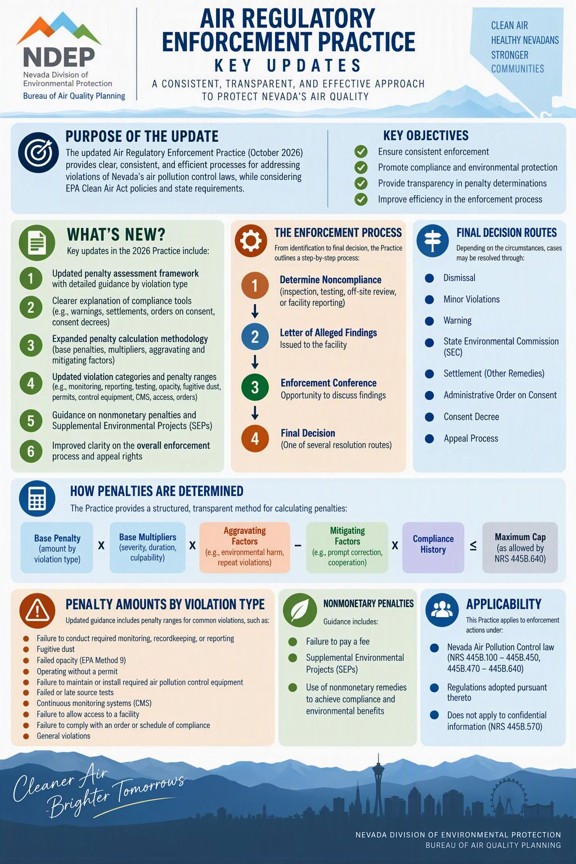
The Air Regulatory Enforcement Practice (Practice) is a guidance document that provides the Nevada Division of Environmental Protection (NDEP) with a penalty assessment framework for consistency in enforcement actions. The purpose of the Practice is to deter noncompliance, promote consistent and proportional penalties, provide a defensible enforcement basis, and address the potential economic advantage of noncompliance. Nevada Revised Statutes (NRS) 445B.640 authorizes the State Environmental Commission (Commission) to assess an administrative fine (penalty) not exceeding $10,000 per day per violation for violations of Nevada Air Pollution Control law. The NDEP – Bureau of Air Quality Planning (BAQP) has finalized the Practice as of October 13, 2026. The Practice will take effect as of November 12, 2026.
What is the NDEP Air Regulatory Enforcement Process?
- Noncompliance may be identified through inspections, compliance testing, off-site record review, or facility reports.
- The typical sequence when noncompliance is identified is to send a Letter of Alleged Findings, followed by an informal enforcement conference, an NDEP decision, and a Notice of Alleged Violation (NOAV), if supported.
- An NOAV may be appealed to the Commission within 10 calendar days of receipt. The Division may bypass the preliminary steps when the BAQP Chief finds that doing so is in the public interest.
- Final decision routes may include the following, in level of severity:
- Dismissal or partial dismissal;
- minor violation;
- warning;
- Commission penalty;
- settlement;
- Supplemental Environmental Project (SEP);
- Administrative Order on Consent; or
- consent decree.
- A SEP generally must equal at least 125% of the penalty mitigated; the minimum recommended penalty for offering a SEP is $15,000.
What is the NDEP Penalty Framework?
The penalty framework is outlined below:
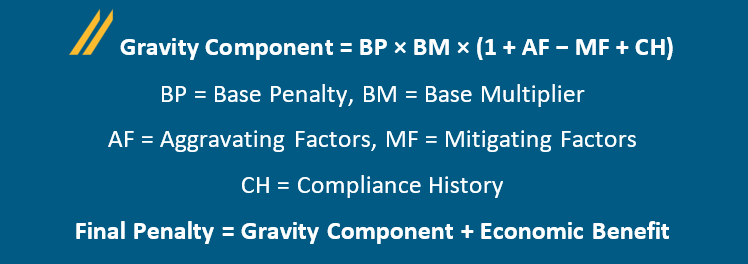
- BP: Base penalty by violation type and source/permit class.
- BM: Event, duration, pollutant, unit/system, exceedance ratio, or other violation-specific multiplier.
- AF: Aggravating factors, including negligence/willfulness, environmental or public-health risk, Hazardous Air Pollutants (HAPs) involvement, federal-limit exceedance, and falsification.
- MF: Mitigating factors, principally effort to comply and timely, complete self-reporting.
- CH: Finalized facility and permit-specific compliance history over the prior 60 months. Same type repeat violations receive substantially larger multipliers.
- Willfulness or falsification can remove otherwise applicable penalty caps.
- Denial of access to an entire facility can be penalized at $10,000 per day until access is granted, with no cap.
- Failure to pay required fees carries a 25% late penalty and may lead to administrative permit termination.
What Violation Categories are Addressed by the Framework?
The penalty assessment framework is used to enforce the following possible types of violations:
- Monitoring/recordkeeping
- Reporting
- Fugitive dust
- Opacity
- Operating-parameter deviations
- Construction/operation without a permit
- Maintenance or missing controls
- Notifications
- Failed/late/manipulated source tests
- Continuous monitoring systems
- Access denial
- Order/schedule noncompliance
- General violations
What Does this Mean for Nevada Facilities?
The Practice standardizes how NDEP evaluates alleged air violations and recommends penalties when it does not seek the statutory maximum. It is guidance, not a regulation; governing statutes and regulations control. Maximum authority remains $10,000 per day per violation. The latest guidance is available on the NDEP webpage. An infographic summarizing the changes discussed herein is provided at the end of this article.
How can ALL4 Help?
ALL4 has over 200 air practitioners, with dedicated permitting and compliance experience in Nevada and surrounding states. We have helped numerous facilities understand agency policies and regulations, implement regulatory requirements, and develop compliance programs and tools. For questions about this topic or how it may affect your facility please contact Megan Neiderhiser (mneiderhiser@all4inc.com), ALL4 Principal.