On August 26, 2026, President Donald J. Trump signed Executive Order 14421 (EO) titled “Declaring a National Emergency to Secure the United States Bulk-Power System” under the authority of the International Emergency Economic Powers Act (IEEPA), the National Emergencies Act (NEA), and Section 301 of Title 3 of the United States Code (USC). We saw a similar executive order in May 2020 titled “Securing the United States Bulk-Power System” [Executive Order 13920]. Executive Order 13920 was suspended by President Joseph R. Biden on January 20, 2021 and the December 2020 Prohibition Order to implement Executive Order 13920 was later revoked by the Department of Energy on April 20, 2021. While there are some similarities between these executive orders, the latest significantly broadens the scope of bulk-power system electric equipment included in the order.
Executive Order Summary
The purpose of the EO is to mitigate an overreliance on bulk-power equipment manufactured in countries considered to pose a threat to national security. In 2025, it is estimated that 80% of large power transformers are imported to the U.S.[1] In alignment with President Trump’s America’s AI Action Plan to stabilize the grid as much as possible, the EO prohibits the acquisition, import, transfer, or installation of foreign-produced bulk-power equipment. The EO specifically cites two potential threats: “digital backdoors” that could allow bad actors to remotely access and sabotage critical infrastructure equipment, and supply chain vulnerabilities that could undermine efforts to expand and stabilize the grid. In addition, the EO also requires a retrospective review of existing bulk-power equipment acquired or installed before August 26, 2026 to identify systems that may pose a risk of sabotage or subversion and recommend mitigation measures.
Key Differences Between EO 14421 and EO 13920
Comparing EO 14421 and 13920, we find almost identical language regarding prohibitions on foreign-produced bulk-power equipment, but there are several key areas in EO 14421 that have been strengthened. The first is the authority given to the Secretary of Energy, in coordination with other executive cabinet members, to impose conditions on the continued use of existing foreign-produced bulk-power system electric equipment purchased or installed before the EO. While both EOs include requirements to identify existing foreign-produced equipment and provide recommendations for the isolation and replacement of equipment, EO 14421 goes further by authorizing the Secretary of Energy to regulate the continued use and operation of such equipment. This could include isolating, monitoring, securing, replacing, or even removing existing foreign-produced equipment. However, the Secretary of Energy is required to evaluate reliability, safety, and availability of acceptable replacement equipment before implementing these conditions.
The definition of “bulk-power system electric equipment” has also expanded since May 2020 in alignment with the Administration’s concerns regarding remote access. The newly defined bulk-power system electric equipment now includes the following:
- Utility-scale and other grid-connected inverters
- Battery energy storage systems (BESS)
- Uninterruptible power supply systems supporting critical infrastructure
- Small generators
- Industrial control systems now specifically include remote terminal units, programmable logic controllers (PLCs), and intelligent electronic devices
Additionally included within the scope of the definition of bulk-power system electric equipment are evaluations of software and firmware, remote access capabilities, lifecycle maintenance and update mechanisms, and other supply chain dependencies that could pose a risk to the bulk-power system. The definition greatly expands the scope of equipment and the software that runs them that must be verified throughout the acquisition and installation process.
Timeline for Implementation
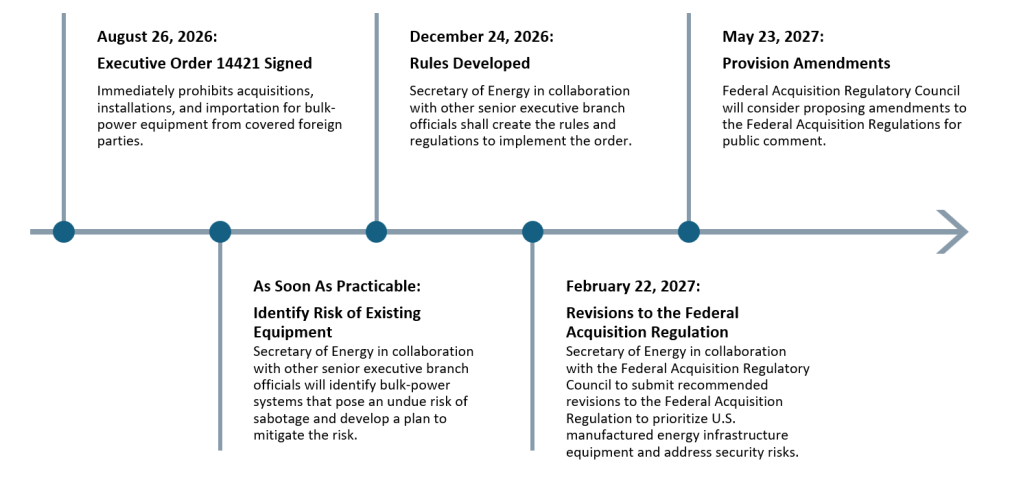
The implementation of EO 14421 will be in phases throughout the end of 2026 through mid-year 2027, starting with specific rules to be developed by the Secretary of Energy to guide the implementation of the EO. The timeline has been outlined in the graphic below:
How Does This Impact My Project?
With the retrospective review of existing equipment included in the EO along with the immediate prohibition of acquisition and importation of foreign-produced bulk-power equipment, the delay, cost, and additional recordkeeping of critical equipment acquisition will be important considerations for ongoing projects. While additional countries may be added to the list, the term “Covered Foreign Entity” currently includes governments that are subject to an arms embargo or sanctions regime under the International Traffic in Arms Regulations, most notably China. With much of the global market share of transformers and BESS originating from Chinese manufacturers2, sourcing critical transmission and storage equipment for projects could be a bottleneck for power generation projects struggling with supply chain constraints as they rush to market. However, this order does not just isolate China but opens the door for a broader definition which could further exacerbate these supply chain concerns, especially if domestic suppliers are unable to make up for the gaps in equipment availability.
In the interim, it is critical to take inventory of existing purchase orders and installed equipment to identify compliance concerns with the requirements of EO 14421. In addition, new procedures for increased scrutiny of equipment vendors and compliance documentation throughout the equipment acquisition process should be implemented. Developers should also assess the financial risk of grid upgrades in response to the EO. ALL4 will continue to review the latest on this executive order and guidance provided through the Office of the Secretary of Energy. To discuss how these changes may impact your project, please reach out to me at akelley@all4inc.com or ALL4’s Power Sector Lead Rich Hamel at rhamel@all4inc.com.
1https://rmi.org/resources/solving-the-gridlock-americas-electric-supply-chain-opportunity/